Archive for Water Resources Development Act (WRDA)
Two Years Later: Dolphins Struggling
April 19, 2012 | Posted by Lacey McCormick in BP Oil Disaster, NOAA, Two Years Later, Water Resources Development Act (WRDA)Two years after the start of the BP oil spill, dolphins in the northern Gulf of Mexico are dying in unprecedented numbers. This month marks a record-shattering 26 consecutive months of above-average dolphin strandings. Only 5 percent of the stranded dolphins were recovered alive and their prognosis was usually poor.
The National Oceanic and Atmospheric Administration (NOAA) recently did an in-depth study of 32 dolphins in Barataria Bay, an area that was heavily oiled during the BP oil spill. The researchers found that many of the animals were underweight, anemic, had low hormone levels, low blood sugar, and some had signs of liver damage. These symptoms are consistent with those seen in other mammals exposed to oil. One of the dolphins in the study has since been found dead.
As a top-level predator, the poor health of dolphins in the most heavily oiled areas suggests possible ecosystem-wide effects of the oil. Dolphins can inhale oil vapors, ingest oil when feeding, absorb it through their skin or eat contaminated fish.
Scientists with NOAA are continuing to investigate the factors that may be contributing to the dolphin mortalities.
No CommentsLouisiana Coastal Area 6 Project Profile: Medium Diversion at White Ditch
December 8, 2010 | Posted by Delta Dispatches in Congress, Louisiana Coastal Area (LCA), Restoration Projects, Water Resources Development Act (WRDA), Whites DitchBy Angelina Freeman, Environmental Defense Fund
The Coalition to Restore Coastal Louisiana, Lake Pontchartrain Basin Foundation, Environmental Defense Fund and National Audubon Society reviewed and provided comments on the six near-term Louisiana Coastal Area (LCA 6) project reports and final environmental impact statements.
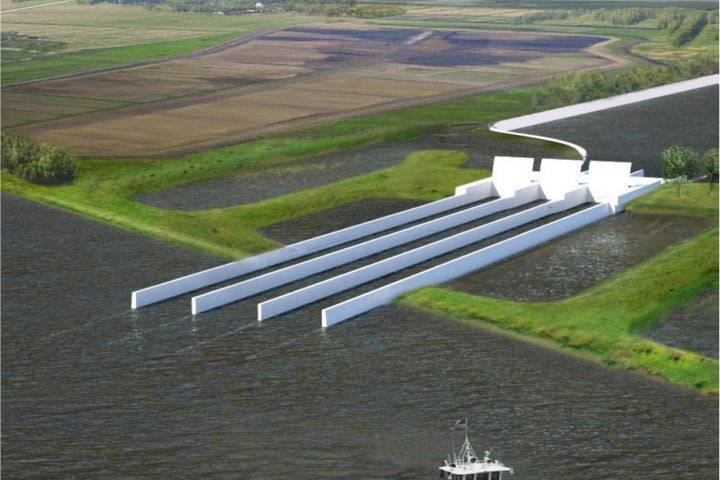
Among the LCA 6, perhaps the most ground-breaking is the tentatively selected plan that incorporates pulsing for the Medium Diversion at White Ditch. White Ditch would provide freshwater, nutrients and sediments to restore degraded habitat and sustain a larger coastal ecosystem east of the Mississippi to support and protect the environment, economy and culture of southern Louisiana.
“We support and commend the recommended plan incorporating pulsing at 35,000 cfs (cubic feet per second) at high river flows to maximize sediment capture in the planning and operation of the diversion," stated the groups in their letter to the Corps. "We agree that the recommended plan meets the LCA program and project objectives and is within the scope of the WRDA [Water Resources Development Act] authorization, and therefore agree that Congress raise the total project cost for the Medium Diversion at White Ditch Project.”
The recommended plan requires congressional action. The groups pledge to work with the newly-elected Congress to secure legislation required to change the authorization and funding required to begin project construction.
The White Ditch project is entering the Planning, Engineering, and Design (PED) phase. Sediment concentrations in the Mississippi River can vary significantly according to location, and the groups recommend a thorough analysis of site specific data and modeling in PED to improve prediction of the sediment efficiency of the diversion relative to location. The groups also recommended reevaluating the conveyance channel and whether natural channel formation can be effectively utilized allowing the engineering to be scaled back (thereby reducing cost) to be investigated in PED.
1 CommentPublic Scoping Meetings Held for Myrtle Grove Diversion
December 1, 2010 | Posted by Delta Dispatches in Louisiana Coastal Area (LCA), Myrtle Grove Sediment Diversion, Restoration Projects, Water Resources Development Act (WRDA)By Maura Wood, National Wildlife Federation
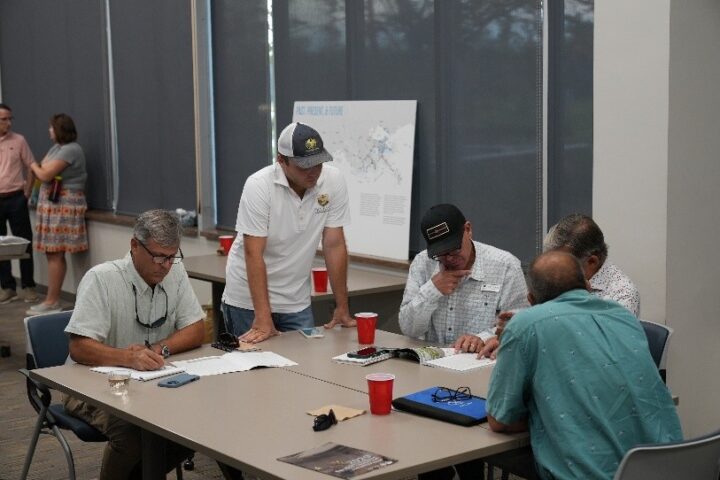
Last week, members of the public were invited to attend and participate in a series of scoping meetings about the proposed Myrtle Grove Diversion in southern Louisiana. The three public meetings officially launched the Environmental Impact Statement (EIS)/Feasibility Study for the Myrtle Grove Diversion. Ensuring that Myrtle Grove is constructed as a land-building, pulsed, sediment diversion is a key element of our coalition's coastal restoration campaign. Scoping meetings allow stakeholders the opportunity to give input about the potential impacts the project.
Myrtle Grove is one of 15 coastal restoration projects authorized by Congress in the Water Resources Development Act of 2007. It was authorized as a medium diversion with dedicated dredging under a program called the Louisiana Coastal Area Study. Our partnership has worked with state officials to gather data and model scenarios of a “modified” Myrtle Grove, which functions as a sediment diversion and employs pulsing to make maximum use of the river's sediment for land building.
At the meetings, members of the public requested that the EIS examine impacts to fisheries and to local communities that might be flooded by water from a diversion. At the same time, many speakers firmly stated the need to get sediment into deteriorating basins and recognized that local conditions would change and some uses would move within the estuary.
One frequent suggestion already has been adopted: the Army Corps of Engineers (Corps) has promised to meet with stakeholders on a regular basis during the EIS process. These meetings will enable information to flow back and forth between the Corps and the public and bring engineering expertise together with intimate local knowledge of the area. NWF will play a role in convening these quarterly meetings.
No Comments